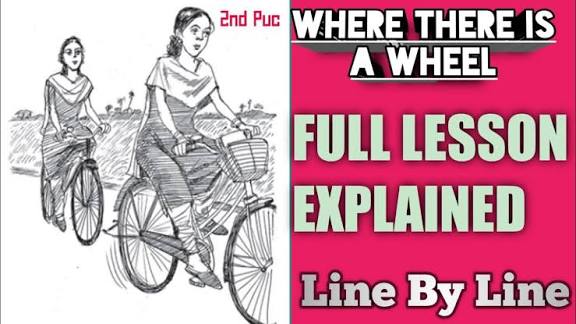
Of course. Here is a detailed summary and analysis of the 2nd PUC English (Karnataka) Chapter 13, “Where There is a Wheel” by P. Sainath.
Chapter 13: Where There is a Wheel
Author: P. Sainath (Renowned Indian journalist and chronicler of rural India)
Source: The essay is adapted from his acclaimed book “Everybody Loves a Good Drought: Stories from India’s Poorest Districts.”
Summary
“Where There is a Wheel” is a powerful and inspirational documentary essay that highlights a remarkable social revolution in the Pudukkottai district of Tamil Nadu in the early 1990s. The revolution was not political, but social and personal, centered around a simple object: the bicycle.
The essay details how the Arivoli Iyakkam (the Light of Knowledge Movement), a grassroots literacy movement, initiated bicycle training camps for rural women. What started as a literacy drive soon unlocked a powerful tool for empowerment. Learning to cycle gave women unprecedented mobility, freedom, and confidence.
Sainath provides vivid anecdotes and data to show the impact:
· Freedom of Movement: Women could now travel to markets, banks, and government offices independently, without relying on male family members or expensive bus fares.
· Economic Independence: They could transport goods, manage small businesses, and access better prices for their produce.
· Social Confidence: Cycling became a symbol of self-reliance. Women who learned to cycle often went on to learn other skills, participate in village councils, and challenge traditional gender norms.
· Scale of the Movement: The phenomenon was massive. Thousands of women, from young girls to elderly grandmothers, learned to cycle. The district saw a dramatic spike in bicycle sales, with women constituting a significant portion of buyers.
· Overcoming Ridicule: The women faced initial ridicule and opposition from conservative sections of society, but their determination and the obvious benefits silenced the critics. The bicycle became a “symbol of rebellion.”
The title plays on the proverb “Where there is a will, there is a way.” Sainath subverts it to “Where there is a wheel, there is a way”—emphasizing that the physical tool (the wheel) enabled the psychological will (the way) to forge a new path towards independence.
Key Themes
- Women Empowerment: The core theme. The bicycle is presented as an instrument of liberation from patriarchal constraints.
- Literacy and Beyond: Shows how functional literacy (Arivoli) must be linked to tools of agency to bring about real change.
- Self-Reliance and Dignity: Cycling boosted self-esteem and gave women a new identity beyond traditional roles.
- Social Change from Grassroots: Highlights how a simple, low-cost innovation can trigger a broader social transformation more effectively than top-down policies.
- Rural Development: Presents a successful model of development that is need-based, participatory, and sustainable.
Important Extracts & Questions
- “Cycling for women is not just about mobility. It’s about dignity.”
· Significance: This line captures the essay’s essence. The bicycle restored dignity by reducing dependence, saving women from long, arduous walks, and giving them control over their time and movement.
- “Where there is a wheel, there is a way.”
· Significance: A creative twist on the old proverb. It argues that sometimes, providing the right tool (wheel) can create the opportunity (way) for people to unleash their own willpower and transform their lives.
- Role of Arivoli Iyakkam:
The movement acted as a catalyst. It identified a practical need (mobility for women literacy workers) and addressed it through cycling camps. This practical skill yielded greater empowerment than theoretical lessons alone. - Impact on Society:
- Economic: Better market access, savings on transport, new income avenues.
- Social: Challenged gender stereotypes, increased participation in public life.
- Psychological: Greater confidence, self-respect, and a sense of freedom.
- Why was there initial opposition?
Conservative mindsets viewed women cycling as “shameless” and a threat to traditional social structures that controlled women’s mobility and behavior.
Character Highlights (Real People cited by Sainath)
· The 60-year-old grandmother: Learning to cycle, showing it’s never too late.
· Sheela Rani: The “star performer” who inspired hundreds.
· The village midwife: Who could now reach patients faster, saving lives.
· The social activist: Who noted the bicycle did more for women’s liberation than abstract ideology.
Why is this Chapter Important?
· Relevance: It presents a tangible, replicable success story in women’s empowerment.
· Journalistic Style: Showcases P. Sainath’s style of “development journalism”—giving voice to the marginalized and highlighting stories of hope from rural India.
· Exam Focus: It is a frequent source for 1, 2, 3, 5, and 10-mark questions, focusing on themes, characters, and the significance of the movement.
In essence, “Where There is a Wheel” is not just about cycling. It is a testament to how equipping individuals with the right tools can set in motion a wheel of change, driving them towards dignity, freedom, and self-determination.