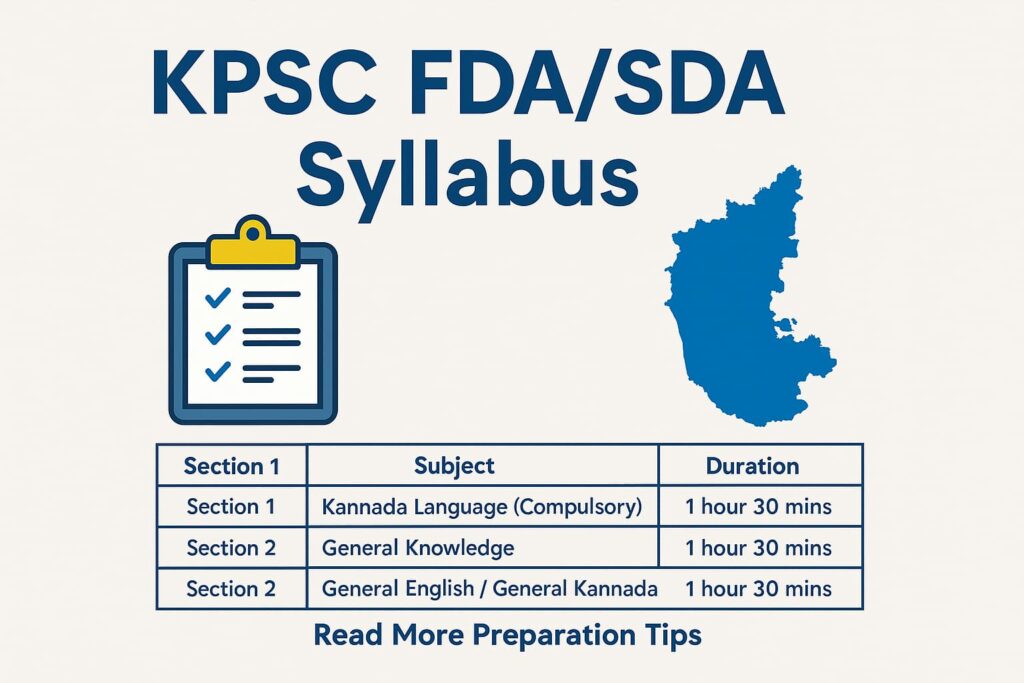
Of course! Here is a detailed, structured breakdown of the syllabus for the Karnataka KPSC FDA (First Division Assistant) and SDA (Second Division Assistant) examination, based on the latest official notifications and previous years’ patterns.
Exam Pattern Overview
The exam is conducted in two stages:
- Written Examination (Objective Type – OMR Based)
- Kannada Language Test (Qualifying in nature)
Stage 1: Written Examination
The written exam consists of two papers, each of 150 marks and 2 hours duration.
Paper-I: General Studies & General Knowledge (150 Marks)
This paper tests the candidate’s awareness and knowledge of current events and issues of state, national, and international importance.
Detailed Syllabus:
- Current Events: Major contemporary events and issues of State (Karnataka), National, and International importance.
- Indian History & Culture:
· Ancient, Medieval, and Modern History of India (with a focus on Karnataka’s history).
· Indian National Movement and its leaders.
· Cultural Heritage of India and Karnataka (Art, Literature, Architecture). - Indian & Karnataka Geography:
· Physical, Social, and Economic Geography of India and Karnataka.
· Climate, Rivers, Soils, Forests, Agriculture, Mineral Resources.
· Demographics, Urbanization, and Environmental issues. - Indian Polity & Economy:
· Constitution of India: Preamble, Fundamental Rights & Duties, Directive Principles.
· Parliament, Judiciary, Executive, Constitutional Bodies.
· Panchayat Raj System and Urban Local Bodies.
· Indian Economy: Planning, Economic Reforms, Budget, Major Sectors (Agriculture, Industry, Services).
· Karnataka’s Economy: Major Industries, IT/BT, Welfare Schemes. - General Science:
· Basic principles and everyday applications of Physics, Chemistry, and Biology.
· Health, Nutrition, and Human Diseases.
· Recent developments in Science & Technology (Space, IT, Biotechnology, Nanotech). - Environmental Issues & Disaster Management:
· Ecology, Biodiversity, Climate Change.
· Environmental Pollution and its control.
· Natural Disaster Management principles. - Mental Ability:
· Logical Reasoning (Analogy, Classification, Series, Coding-Decoding).
· Quantitative Aptitude (Basic Numbers, Percentage, Ratio, Average, Simple Interest).
· Comprehension & Interpretation of Data (Charts, Graphs).
Paper-II: General English & General Kannada (150 Marks)
This paper tests the candidate’s comprehension and language skills.
Part A: General English (75 Marks)
- Grammar & Usage: Articles, Prepositions, Tenses, Voice, Narration, Subject-Verb Agreement.
- Vocabulary: Synonyms, Antonyms, One-word Substitutes, Idioms & Phrases, Word Formation.
- Comprehension: An unseen passage followed by questions.
- Composition: Letter Writing (Formal/Informal), Paragraph Writing, Essay Writing, Precis Writing.
- Error Detection in sentences.
Part B: General Kannada (75 Marks)
(For candidates claiming eligibility with Kannada as a language subject up to 10th standard)
- ಭಾಷಾ ಜ್ಞಾನ (Language Knowledge): ವ್ಯಾಕರಣ (Grammar) – ಸಂಧಿ, ಸಮಾಸ, ಕ್ರಿಯಾಪದ, ವಿಭಕ್ತಿ ಪ್ರತ್ಯಯಗಳು, ಲಿಂಗ, ವಚನ.
- ಶಬ್ದ ಜ್ಞಾನ (Vocabulary): ಪರ್ಯಾಯ ಪದಗಳು (Synonyms), ವಿರುದ್ಧಾರ್ಥಕ ಪದಗಳು (Antonyms), ವಾಕ್ಯ ಪ್ರಯೋಗ.
- ಗದ್ಯ ಮತ್ತು ಪದ್ಯ ಬಿಡಿ ಪಂಕ್ತಿಗಳ ಅರ್ಥ (Comprehension): ಗದ್ಯ ಅಥವಾ ಪದ್ಯ ಭಾಗವನ್ನು ಓದಿ, ಪ್ರಶ್ನೆಗಳಿಗೆ ಉತ್ತರಿಸುವುದು.
- ರಚನೆ (Composition): ಪತ್ರಲೇಖನ (ಔಪಚಾರಿಕ/ಅನೌಪಚಾರಿಕ), ಪ್ರಬಂಧ ರಚನೆ, ಸಾರಾಂಶಲೇಖನ (Precis Writing).
Stage 2: Kannada Language Test
· This is a qualifying examination only.
· Candidates must secure a minimum of 35% (30% for reserved categories) to pass.
· It tests the basic speaking, reading, and writing skills in Kannada.
· Syllabus: Dictation, Conversation, Comprehension, Translation from English to Kannada (simple sentences).
Key Preparation Resources & Books
For General Studies:
· NCERT Books (Class 6-12) for History, Geography, Polity, Science, and Economics.
· “Karnataka: A Comprehensive Guide” by K. Shivashankaran (for Karnataka-specific topics).
· “Lucent’s General Knowledge” (for quick revision of Science, History, etc.).
· Daily Newspapers (The Hindu, Prajavani) and Monthly Current Affairs Magazines (Vision IAS, PT 365).
· Karnataka Government’s official website for state schemes.
For English:
· “Objective General English” by S.P. Bakshi or R.S. Aggarwal.
· “High School English Grammar & Composition” by Wren & Martin.
For Kannada:
· “ಸಾಮಾನ್ಯ ಕನ್ನಡ” by various authors (Prabha Publishers, Sapna Book House).
· “ಕನ್ನಡ ವ್ಯಾಕರಣ ದೀಪಿಕೆ”.
· Practice with previous years’ question papers.
Practice is Key:
· Solve previous years’ KPSC FDA/SDA question papers to understand the pattern and difficulty level.
· Take online mock tests regularly.
Important Notes:
- Always refer to the latest official notification on the KPSC website (www.kpsc.kar.nic.in) for any syllabus or pattern changes.
- The final selection is based only on the marks of the Written Examination, provided the candidate qualifies in the Kannada Language Test.
- Negative Marking: Usually, there is no negative marking in the written exam, but confirm this in the latest notification.
Best of luck with your preparation! A consistent, syllabus-focused study plan is the key to success.